Where spraying wins
Hand application leaves laps, and laps are where barrier systems fail. On a flat, square wall that is manageable. On a barrel-vaulted coal cellar with arched openings, stepped haunches and a dozen changes of plane, it is a long list of vulnerable joints.
A sprayed system covers all of it in a uniform thickness with no joints at all, and it does so quickly — which matters when the structure is exposed and the weather is not on your side.
Outside is better, when outside is available
A barrier can go on either face of a wall, and that choice matters more than the material does. Applied externally it sits on the positive side — the side the water is on — and ground water presses it against the structure. Applied internally it sits on the negative side, where the same pressure spends the life of the building trying to push it back off. Given a free choice, every barrier system would go on the outside.
You rarely get a free choice. An existing London cellar has a pavement, a neighbour or somebody's garden on the far side of the wall, and excavating to reach it would be a larger job than the waterproofing. That is why our Type A work is usually internal and usually sprayed: the constraint is access, not preference, and a sprayed coat is the best answer available on the face we can actually reach.
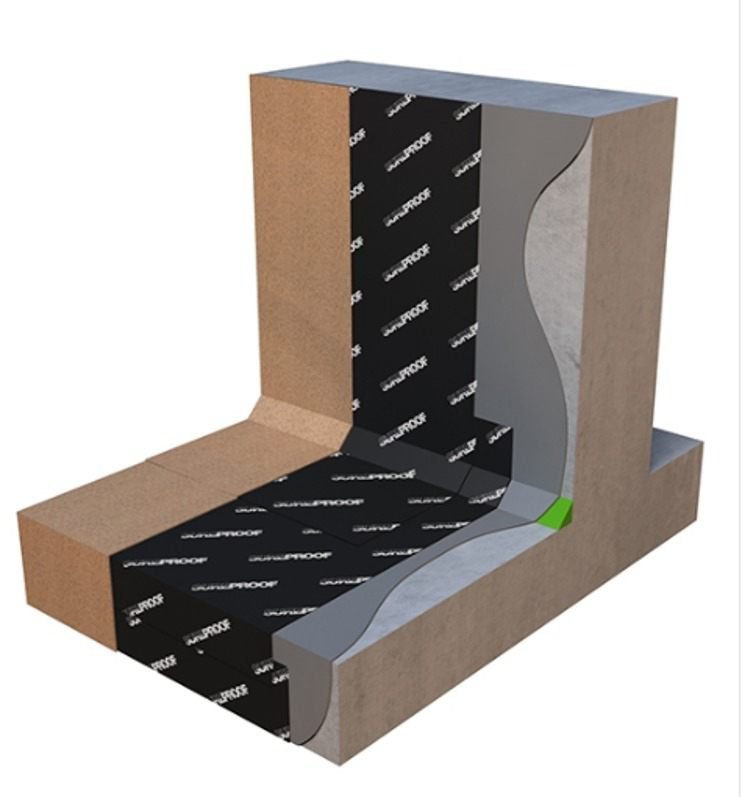
Where there is a dig — a new basement box, an underpinned extension, a lowered floor with the excavation still open — the answer changes, and so does the material. On a new wall that is flat and regular, a self-adhesive sheet on the outside face is the stronger system, and the objection to sheet stops applying: the laps fall in straight runs where they are designed to, rather than round an arch. We use Wykamol SureProof for that, and it is in the materials below.
Both are Type A and both are barrier protection under BS 8102. Which one is right is settled by whether anyone can get to the outside of your wall — a question about your site rather than about waterproofing, and one we answer at survey before recommending either.
What it demands in return
A barrier system is only as good as what it is stuck to. The substrate has to be sound, clean and properly prepared, and any existing failed tanking generally has to come off rather than be sprayed over. Where the structure is moving, or where the head of water is high and not fully understood, Type A is the wrong choice and we will say so — a barrier that fails has no second line behind it.
This is the honest limit of the system, and it is the reason we survey properly before recommending it.
The rig, and why it matters
We spray with an InoBEAM M8 peristaltic pump. The pump type is not a detail — it decides what can be sprayed and what the coat is like when it lands. In a peristaltic pump the material never touches an impeller or a piston; a roller squeezes it along the inside of a hose. A two-part cementitious membrane with crystalline additives arrives at the wall chemically as it left the hopper, rather than sheared by the pump on the way.
It delivers up to 8 litres a minute at 15 bar, through 30 metres of hose and 20 metres of lift, off a normal 230V socket. That combination is what makes it usable in somebody's home: the rig stays at the top of the stairs, nothing heavy is carried down into a Victorian cellar, no plant sits in the room being coated, and there is no generator running outside a family house all day.
The practical result is a whole vaulted cellar going on in one uninterrupted pass at a consistent film thickness. No cold joints where a bucket ran out, no laps where a brush had to stop and start, and a uniform build over arches and stepped haunches that hand application cannot match. The same pump also handles grouts and injection mortars, so structural repair and waterproofing happen on one visit rather than as two contractors blaming each other.
Where we use it
Sound structures with a modest, well-characterised head of water; vaulted and irregular cellars where jointing would otherwise be extensive; and as part of a combined approach where a barrier to one element sits alongside drained protection elsewhere.